
Platforms Pick 7, Part 2: The Publisher’s Side


November, 2026
The Paradox
Advertisers know journalism makes for higher quality content than an Instagram feed. But ask just about any brand marketer which is getting a greater share of their ad budget this year. Instagram wins.
This requires explanation. The easy answers reference scale or the ease of one-stop shopping in a platform like Meta’s. These are true but beside the point. The vast majority of journalism is on the open internet. Its inventory is high-quality and performant by any human judgment, yet it monetizes worse. This is not a scale or an ease-of-use problem. It is a pricing problem, specifically the one where platforms pick 7.
When many advertisers are served by one predictive bidding model, the model converges on the answer that is least wrong for the crowd. All advertisers pay average prices. But what does convergence do on the other side of the auction? That is a story about the publishing business, and why the two sides of digital media took different paths after 2019.
Converging Bids
Every bidder on the open web runs a function. The function puts most of its weight on the user ID, and whether that ID was seen on a conversion page lately. The site of the ad opportunity, the hour, the position on the page all carry small weights. The ID carries the big one.
If every bidder weights the same feature the same way, every bidder arrives at about the same number for a given impression. This is convergence. Convergence is contrary to how auctions are supposed to work.
An auction is supposed to discover what the most interested buyer will pay. It works when bidders disagree. When they agree, the auction stops discovering anything. It just collects the consensus price for every auction. The consensus price is not any advertiser’s price. Nor does it represent the distribution of many advertisers’ optimal prices. It collapses that distribution into the mode, the bid that makes the crowd happiest.
This is a problem for big advertisers with unique growth challenges. But convergence is worse than that. Bidders do not just agree on price. They agree on which impressions to want. An impression carrying a matched ID with recent conversion history looks valuable to all fifteen bidders at once. They pile in. An impression without one looks worthless to all fifteen. Nobody bids.
So demand lands on a narrow slice of inventory and leaves the rest empty. Publishers see this every day. Roughly a fifth of their impressions draw competitive bids. The rest clear at the floor or not at all.
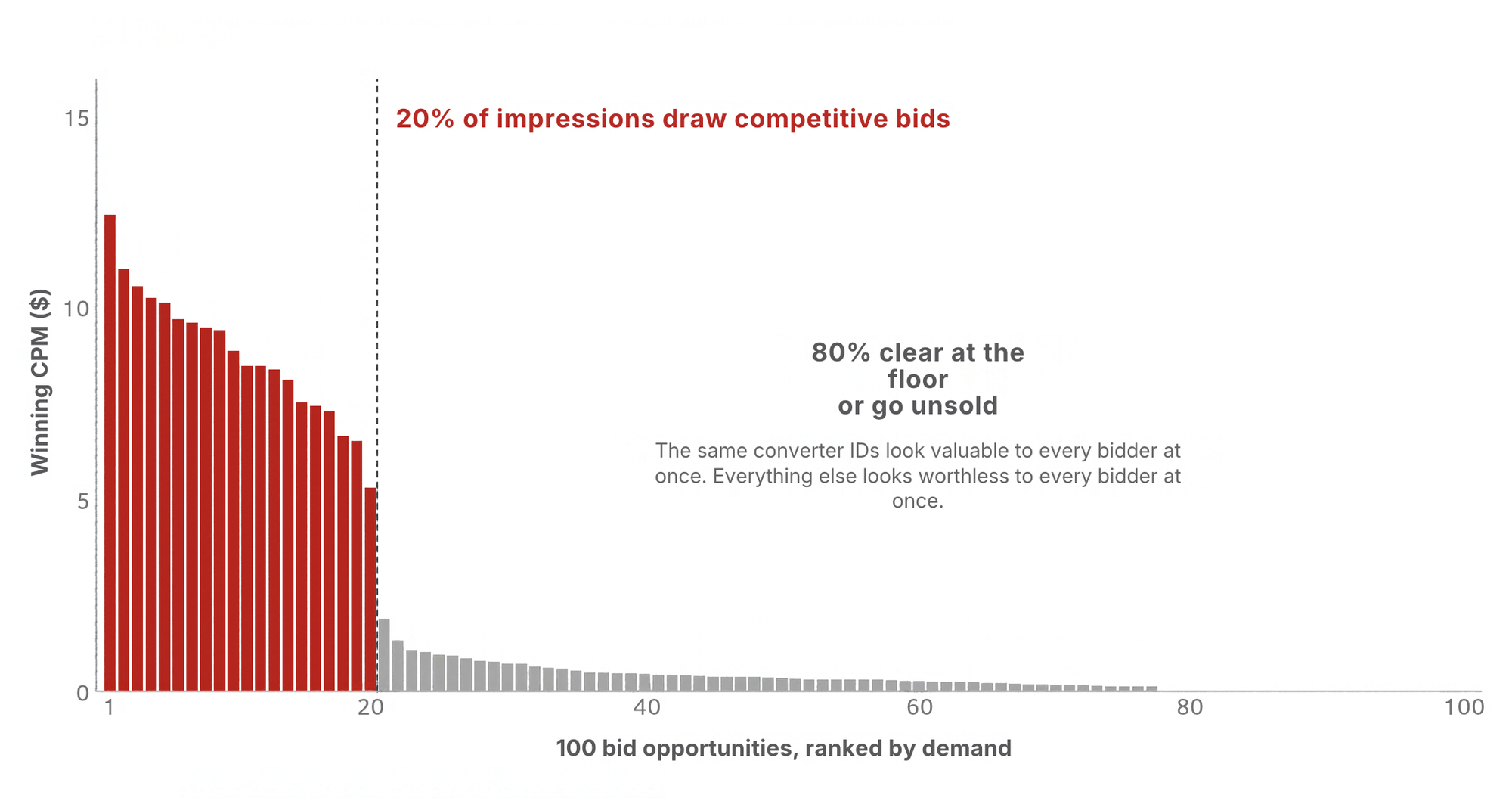
That cliff is mode-collapse viewed from the supply side. The lumpy curve of human interest in a page has been replaced by a spike against impressions the model is interested in for everyone. The lack of diversity in bidder interest, to a publisher, means poor allocation of demand across its diverse supply. An auction among bidders with matching valuations cannot spread demand. When every bidder wants the same thing, bidders are a bad allocator.
The Publisher’s Three Levers
Bad allocation is potentially disastrous for the business of a publisher giving away its content, trying to subsist on ad revenue. Its profit is tied to the number of impressions that carry a hot ID, multiplied by a price the publisher cannot influence. The publisher’s business is creating good pages that draw an audience. But nothing about the page gets much weight in the buying algorithm. Nothing about the audience gets weight except platforms’ binary read on each reader’s ID.
That leaves three ways to earn more.
The first is to put more hot IDs in front of the model. The cheapest way to do that is to buy traffic. Users who arrive from a social or search ad come pre-cookied and pre-qualified. They clicked on an ad, so they are the kind of person who clicks on ads. Many of them are already in somebody’s retargeting pool. Send them to a page and the model sees converters.
The second lever is to show each hot ID more impressions. Eight units on the page instead of two. A refresh timer. An infinite scroll. The model does not care whether the ninth impression of a converter did anything. The ninth impression carries the same ID as the first, and the ID is what pays.
Put those two levers together and you have a specification for made-for-advertising sites. MFA is not a trick played on the model. It is the yield-optimal response to a buyer that only sees IDs. Every publisher drifts toward it, because every other improvement to a site moves nothing that informs the buying algorithm.
The third lever is newer and uglier. If the model pays for IDs, and your traffic does not carry them, you can add them. Take an impression on Safari, where there is no cookie. Infer who the user is from a login somewhere else, a hashed email vendor, a household graph or a probabilistic match. Put that ID in the bid request as if the person were present. The model sees a resolved converter where there was a stranger, and bids accordingly.
This is called ID bridging. It is the exact mirror of the surprising way platforms handle unique CRM data, described in Part 1. The publisher has learned there’s no point modeling what the algorithm wants. Its function has one variable that pays: hot IDs. So it supplies that variable directly, and the cheapest version of that is to make them up.
The argument for bridging is that the industry has done probabilistic matching for fifteen years. The argument against is that the buyer thinks it is paying for a deterministic ID and is getting a guess. Until the IAB Tech Lab added fields to disclose the match method in 2024, there was no way to tell the two apart in a bid request. Undisclosed bridging is selling a counterfeit of the only thing the buyer values. And the model cannot detect the counterfeit, because it never learned anything about the user except the ID.
Buyside platforms do not want to show how much of their matched Safari spend was bridged. Sellside platforms do not want to show how they bridge. The truth is out there, waiting to be disclosed as part of yet another open-web scandal.
The PMP Alternative
There is one way to earn more that does not involve becoming a frequency farm. It is to send bid requests outside of the open auction.
Every publisher knows that a deal ID lifts yield. Direct deals, PMPs, curated packages—it almost does not matter what is in the deal. Wrap inventory in a tag and it earns more than the same inventory in the open auction.
The natural explanation is that the deal signals quality the model missed. That is half right. The deal does carry value the model cannot price. But the lift mostly does not come from the model reading that value. It comes from the deal taking the impression out of the model’s pricing altogether.
Inside a DSP, it’s easy to give deals their own line item, budget and base bid. (Fixed-price deals are not bid at all.) On auction deals, bid shading is typically relaxed. The line item has money that has to pace. So a human’s judgment about what the inventory is worth replaces the crowd’s. The publisher gets paid the human’s number. That might cause the majority of lift from curation overall.
Like the tag on IDs from a buyer’s CRM, the deal is a label that lets a buyer act on a belief the model has no slot for. The belief is not learned. It is exempted. That explains why junk deals lift yield too. What is being achieved is not discovery. It is escape from a price-setter that does not find undervalued inventory, because it’s not designed to.
It also explains something that should be embarrassing for the platforms. Deals often perform better than the open auction on the platform’s own metrics. A pooled model is least wrong for everyone on average. It is not right for anyone in particular. A trader who sets up a deal is injecting one advertiser’s knowledge: this audience fits our strategy, this context matters in our category. That is a crude per-advertiser model. When it beats the pooled model for that advertiser, you are watching the gap between the crowd’s weights and the advertiser’s weights show up as performance lift.
So publishers have two options. In the open auction, the play is to become a frequency farm. In deals, the play is to try and steer buying algorithms against their autopilot. Neither pays for a better site. Trending toward MFA makes your site worse for human readers. The deal premium gets you a read on how much value the pooled function is failing to price.
2019: The Fork
Two things happened to the open web in 2019. Google moved its exchange to first-price auctions. And Safari’s tracking prevention finished off the third-party cookie on Apple devices. Firefox followed. The open web lost the ID on roughly a third of its traffic.
The first-price change was supposed to signal that Google was giving up its last-look advantage. Under second-price, the winner paid what the runner-up bid. That only discovers a price if the runner-up represents a different valuation of the same opportunity. In a market where most bids are on big platforms’ favorite IDs, the runner-up is typically another bidder using the same platform. The platform set its own price, one notch down. When there was no second bid, the auction floor would set the price, had Google not taken floor-setting away from publishers.
First-price did not fix this. It made platform price-setting a bit less clandestine. Bidders began to shade their advertisers’ bids. But the shading algorithms belong to the platforms. So shading openly made all bids the platform’s bids. Shading amounts to platforms naming the crowd’s price for every opportunity.
That said, cookie loss turned out to be the more important event, because of how the open web responded. Having lost its common key, the project became to rebuild the common key. Unified ID 2.0. RampID. Hashed emails. Prebid’s user ID modules. The entire identity industry of the last six years is an effort to put a resolvable ID back on impressions.
Think about what that does inside the function. Every one of those efforts raises the weight on identity relative to everything else. A better-resolved ID is a better predictor. So the model leans on it harder, and other factors, like the page the ad opportunity is on, matter less. That makes opportunities to reach the same user more interchangeable. The platform buys the cheapest one. Spend flows to whoever can show the resolved ID most often, for the lowest price.
The open web’s reaction to the loss of cookies made user IDs more important than cookies ever were. It made the open web more fragile. And it created the market for ID bridging, as demand for hot IDs surpassed the available supply.
Meta after Apple
Meta took a similar hit two years later. In 2021 Apple’s App Tracking Transparency cut off Meta’s view of what users did in other apps and on other sites. Meta said it cost ten billion dollars in 2022. The stock fell by more than 50%.
But look at what Apple actually took. It did not take the ID. Every impression on Meta was still a logged-in person with years of behavior on Meta’s own property. What Apple took was the label. Meta could no longer see which of its users converted off-platform. It lost much of the signal behind the weight that dominates every ad model, which is whether this person has converted before.
That is the opposite of what happened to the open web. Both sides kept their impressions. What changed was what each could know about an impression. The open web could still see who converted, because conversion pixels of advertisers’ websites kept firing. They could no longer see who was in front of 30% of their ads. Meta could still see who was in front of its ads. It could no longer see who converted. One lost user IDs on impressions. The other lost conversion labels.
The responses were opposite. Meta rebuilt the conversion label through a back door. It pushed advertisers onto server-side conversion feeds, and modeled the conversions it could not see. Then it endeavored to model, distinguish and rank users and ads from on-platform behavior, rather than leaning on off-platform conversion history. Meta spent billions on frontier modeling technology, applied to user behavior and advertiser creative. The shift to Reels and the fight with TikTok pushed in the same direction. By 2024 Meta’s ad business was growing faster than it had before Apple intervened.
Meta did not achieve independence from tracking. Conversion labels came back through advertiser use of conversion APIs (CAPI), and Meta still needs them. What Meta achieved is independence from Apple. Its representation of the user is built from behavior that happens on property Meta owns. No browser vendor can redact that data. The open web’s representation of the user was a cookie, which is a key to somebody else’s log. When the key broke, there was nothing behind it.
Meta responded to the shock by deepening what it knew about pages, behavior, and ads. The open web responded by rebuilding IDs. That is the fork, and it explains most of what came after.
Meta’s Spread
Now the paradox resolves. Three things make the feed outperform the open web, and none of them have to do with quality or ease of use.
The first is allocation. The open web runs an auction. Meta runs an allocator. Every impression in the feed is assigned to one advertiser by a single system that knows every advertiser’s budget, bid and pacing. Meta’s model converges like everyone’s. It picks 7. But there is no collision, because one allocator with full information can spread converging demand across users in a way a fair auction cannot. The open web’s 80% goes unsold because no bidder values it. Meta’s equivalent impressions get sold because the allocator has to put every budget somewhere, and it knows the next-best user for each.
The second is the owned representation. Every impression on Meta is a known person. Not a bridged ID, not a probabilistic match, not a cookie that may or may not resolve. The model’s biggest weight sits on a feature that is present every time.
The third is measurement. Open web attribution runs through pixels and ad servers the advertiser controls, so a third party can audit it. And on unmatched traffic it undercounts, because an unmatched user cannot be attributed at all. Meta’s performance is Meta measuring Meta. No outside pixel fires in the feed. Conversions are matched across devices on a logged-in graph, including view-through, and no one else can see the match. Incrementality tests routinely cut its self-reported lift. The dashboards overstate performance for big brands. But agencies buy on the dashboards.
Add up the factors, and the Instagram feed wins with trash content. The open web’s quality is real. But it is unpriced, because quality is not weighted by platform algorithms, and their models cannot allocate converging demand. Advertisers are not wrong that the news site is better. They are right. Almost nothing in the machine that buys for them can act on it.
What Would Price Quality
There is a simple test for whether a buyer can pay for a better site. Does his platform’s model have a weight for what’s on the page? Almost none do. The ID absorbed that weight years ago, and rebuilding the key only made it worse.
Some startups have found that a crude version of that weight works. Look in one advertiser’s logs for the sites its converters visit. Make a list. Buy on it. That beats the platform’s model often enough to be a business. It is a per-advertiser site weight, fit on one advertiser’s historical data, bearing one advertiser’s label. One custom dimension beats ten million pooled ones, because the one dimension belongs to the advertiser.
The superior version sets out to price quality on the open web for one advertiser at a time. Custom-weight page-level data to represent a buyer whose valuation differs from the crowd’s. Not a better-resolved ID, and not another tag. A model with variables for the content and quality of the page, fit on one brand’s data against one brand’s definition of growth. Curation and supply-side decisioning moved the open web toward Meta’s allocation capability. Per-advertiser models are the express route. They are the only way to pay publishers for the value provided across a diverse pool of advertisers.
The open web has spent six years trying to look more like Meta by rebuilding the ID. It cannot win that way. Meta owns its users, and the open web’s advantage was never identity. It’s that the pages are better, and that the readers are more different from each other than any feed can convey. Those are the tails of the distribution. A machine designed to pick 7 will never see them.
Publishers have a big stake in the success or failure of custom bidding algorithms trained to predict value for one campaign at a time. They are the only machines designed to bid up undervalued inventory until it’s no longer undervalued, and then look for more. Publishers analyzing feedback from these bidders will find clear indications of what pages, content, and audiences are valued by independent buyers, and how those valuations change week-to-week and month-to-month.
It has been reported, with alarm bells, that publishers are losing up to 70% of traffic as AI displaces search and social traffic. It has almost never been reported that a comparable share of publisher traffic is misvalued by bidding machines that converged. Convergence got worse as the open web’s top platforms took more control over advertiser bids while failing at the critical tasks of price discovery and demand allocation. Publishers’ search and social traffic are not recoverable. Yet solutions for price discovery and demand allocation have arrived. They are the same solution: Let a great diversity of bidding algorithms meet the great diversity of the open web.