
The Two Architectures, Part Two: The Demand-Side Decision


July 20th, 2026
Part one argued that media services is splitting into two businesses with different architectures: one optimized for the median advertiser through pooled, platform-driven decisioning, and another built for the enterprise advertiser whose competitive position depends on private valuation the pooled stack cannot accommodate. The argument was structural and largely diagnostic. This piece is operational. It looks at what the price-quality distribution of open-internet inventory actually looks like when measured against independent page-level scoring, and what an enterprise advertiser was able to do with that information on a recent campaign.
The starting observation is one the industry has, to its credit, begun to acknowledge openly. In January 2025, The Trade Desk acquired Sincera. The company’s VP of Inventory Development, Will Doherty, explained the rationale plainly: the bidder had been working with a small fraction of what was actually knowable about the page where an ad would run. Bidstream metadata like domain, slot dimensions, audience segment, plus a handful of standard viewability and fraud signals covers a narrow slice of what determines outcomes. Richer signals such as ad-to-content ratio, ads loading out of view, refresh rates, data fetching patterns, layout cleanliness, and video content duration are measurable, but historically have lived outside the auction in post-campaign analytics rather than inside it at decision time.
Last month, TTD released Sincera Inventory Controls, bringing several of those signals into the buying workflow. It’s a real step and the right move for the platform’s core customer base. The question this piece takes up is what the same step looks like for the enterprise advertiser whose value function does not align with population-average page quality, and what infrastructure that advertiser needs in order to act on richer signals against their own outcomes rather than against the market’s consensus.
What the market is actually pricing
To specify what “thin signals” produce in practice, we looked at three unrelated enterprise advertisers running on the open-web auction in 2026: a global technology advertiser through Omnicom, Hyundai through Canvas Worldwide, and a major grocery advertiser through Dentsu. Each campaign’s served URLs were scored independently across more than 35 empirical page-level quality signals and binned into deciles. We then looked at how impression-weighted clearing CPM tracked, by decile, across each campaign. Roughly 1.4 billion impressions in total, across four independent supply paths, two creative formats, and three advertisers with no operational or vertical overlap. The six cuts cover the open-web display market from three different sides and the open-web video market from two.
We will start with the display side, where the cross-advertiser evidence is strongest, and then turn to what the same analysis looks like in video.
Display: three advertisers and four supply paths
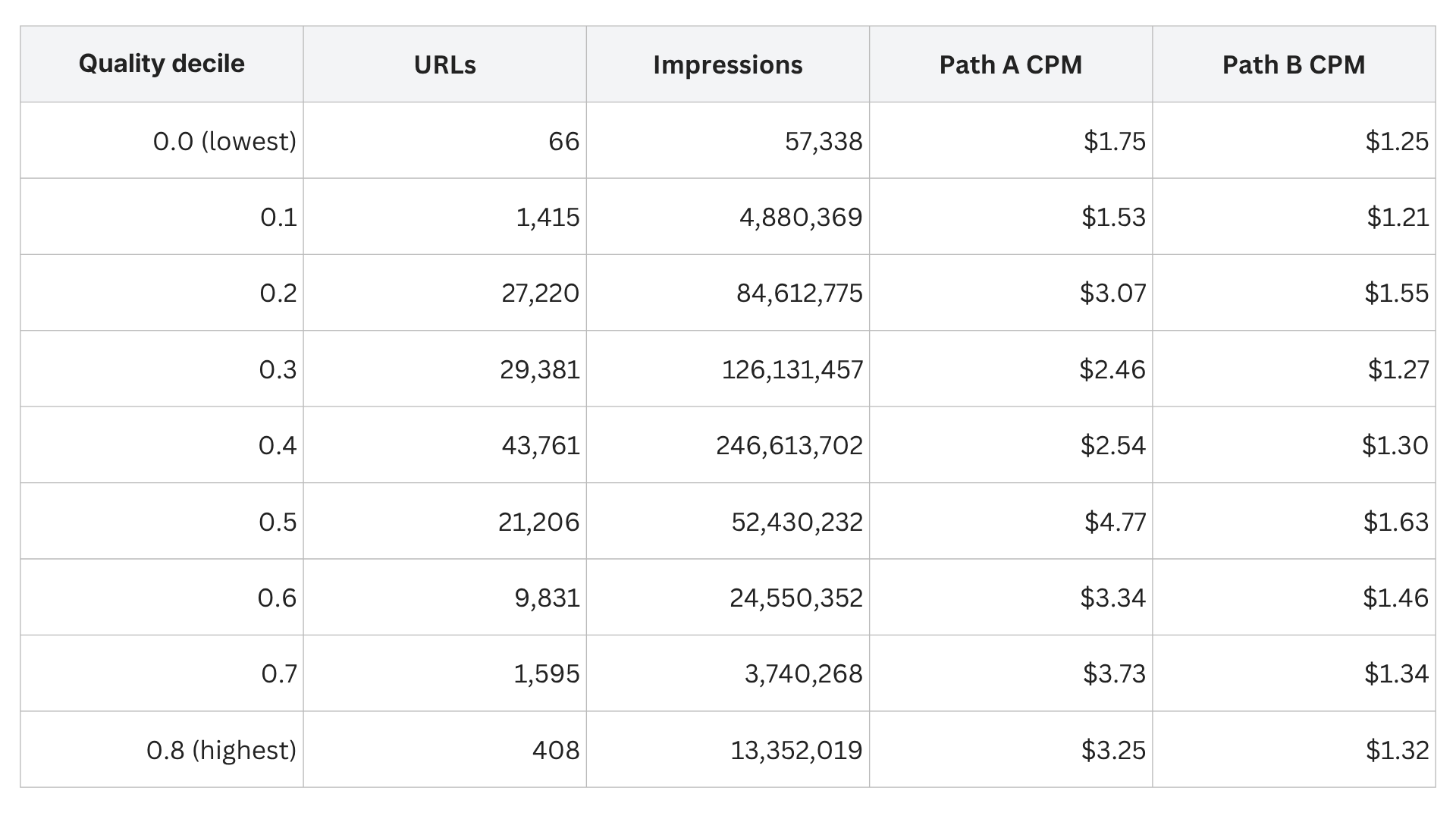
Below is the Omnicom display campaign, with the two supply paths shown separately because they price quality differently and that difference is itself informative. Path A and Path B represent two major SSPs, where the same decisioning logic was deployed.
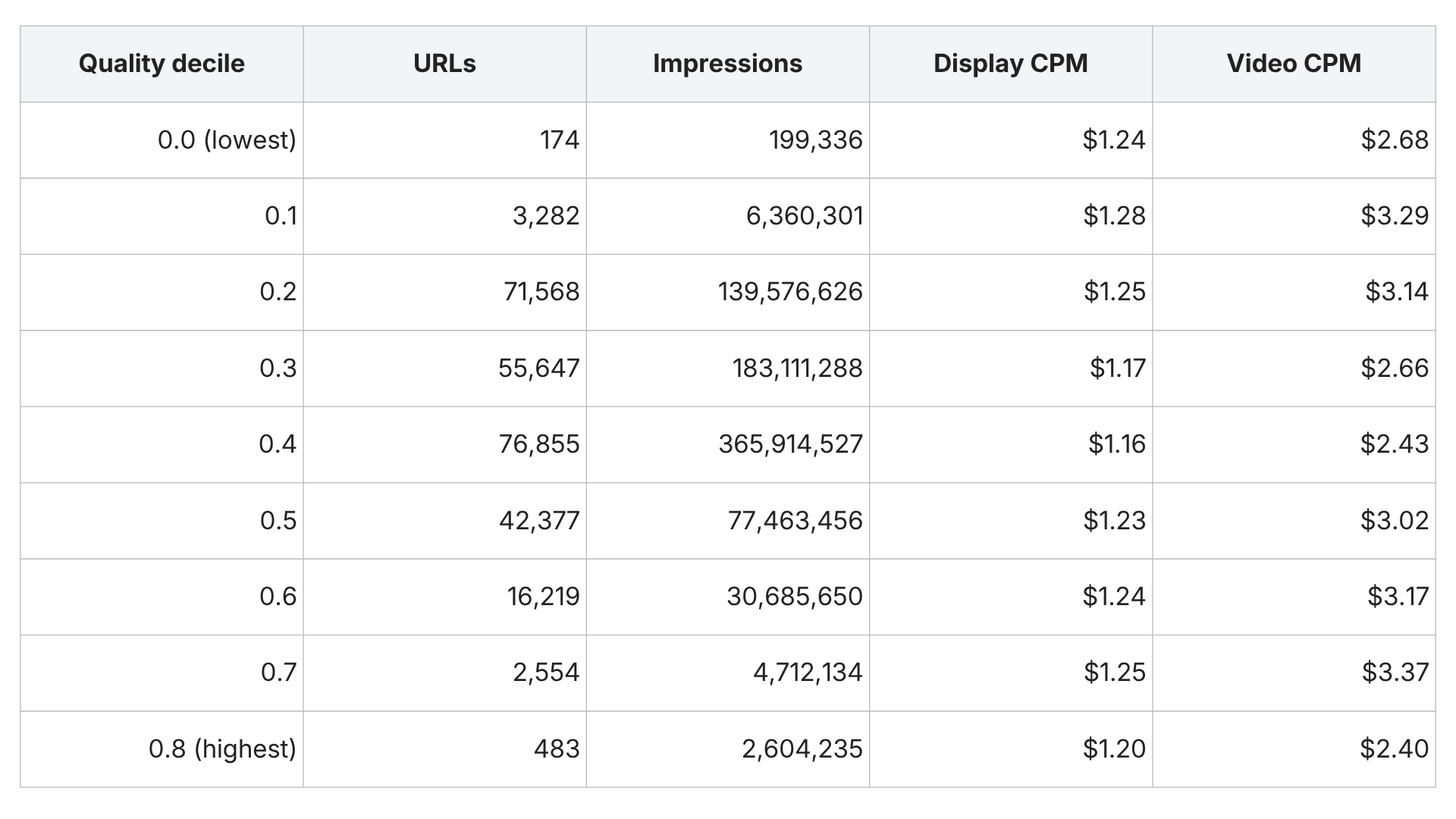
The Hyundai display campaign, on the same scoring methodology applied to its own served URLs, is shown below alongside the Hyundai video data we will turn to shortly.
The Dentsu campaign, on the same scoring methodology applied to its own served URLs, is shown below. The campaign ran in 2026 as a parallel display-and-video buy. Its display volumes are smaller than the Omnicom or Hyundai cuts, but the price-quality picture across deciles is consistent with both, and the video data tracks within an unusually narrow band.
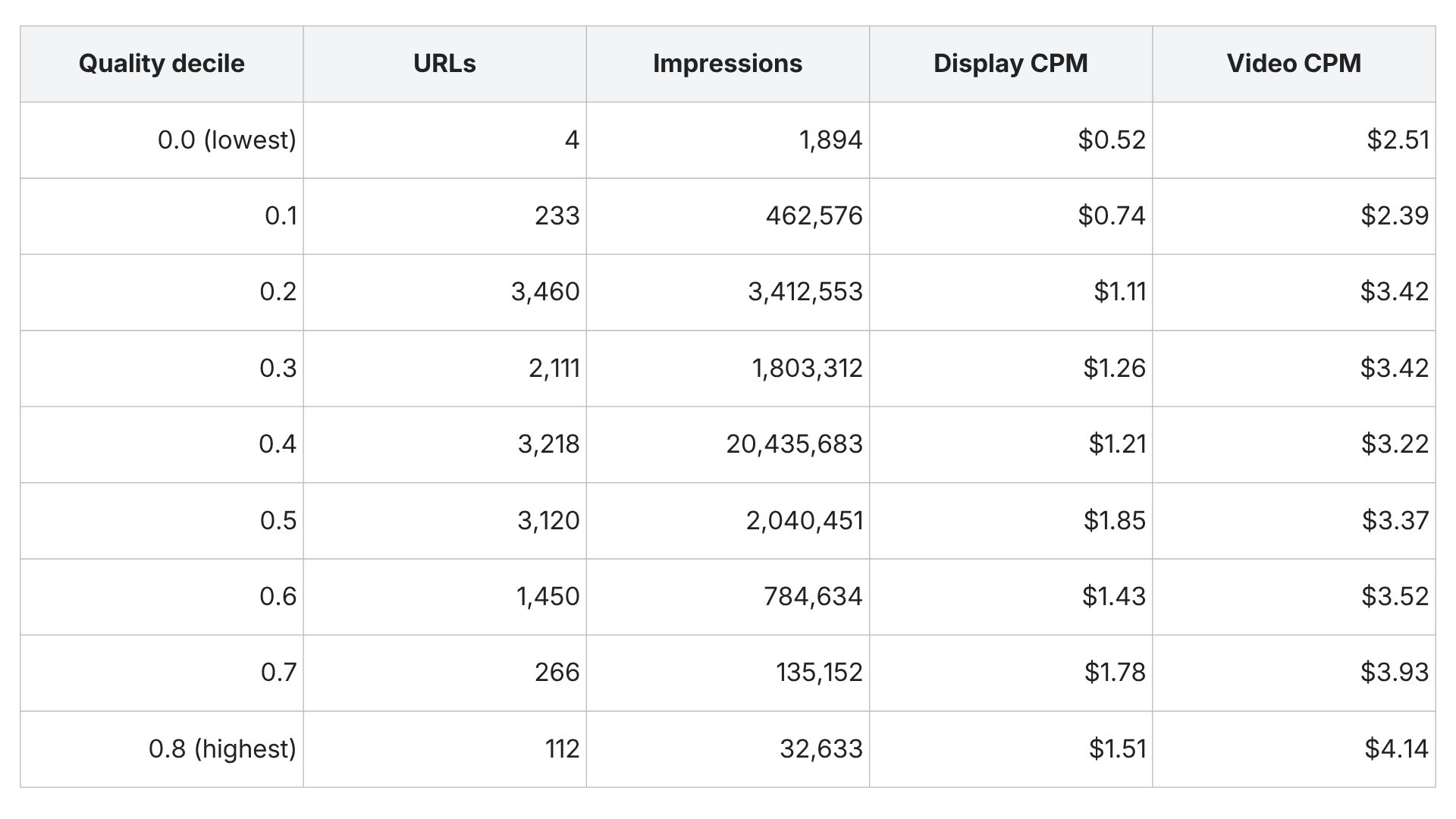
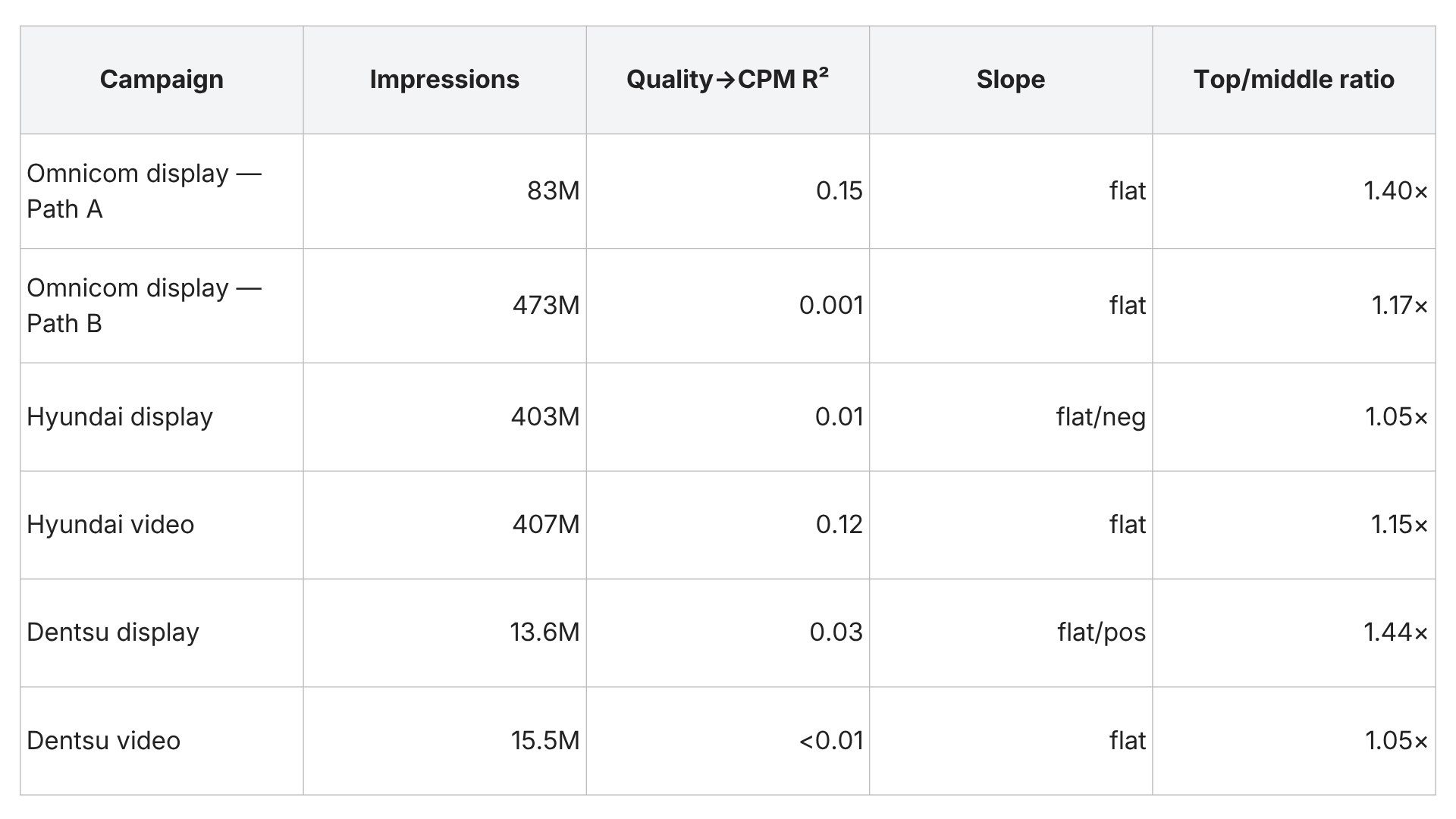
On the display side, taking the four supply paths together, the picture is consistent. Across roughly 970 million display impressions, the relationship between independent page-level quality and clearing CPM produces an R² of 0.15 on one of Omnicom’s curated paths, essentially zero on the other, 0.01 on Hyundai’s display path, and 0.03 on Dentsu’s display path. The ratio of top-decile CPMs to middle-decile CPMs ranges from 1.05× to 1.44×. The volume buckets where most spend lives – deciles 0.2 through 0.5 – are priced largely flat to each other regardless of their actual quality. On the supply paths and at the volumes that actually move money on the open web, the market is not pricing page quality with anything close to the fidelity independent scoring shows is available.
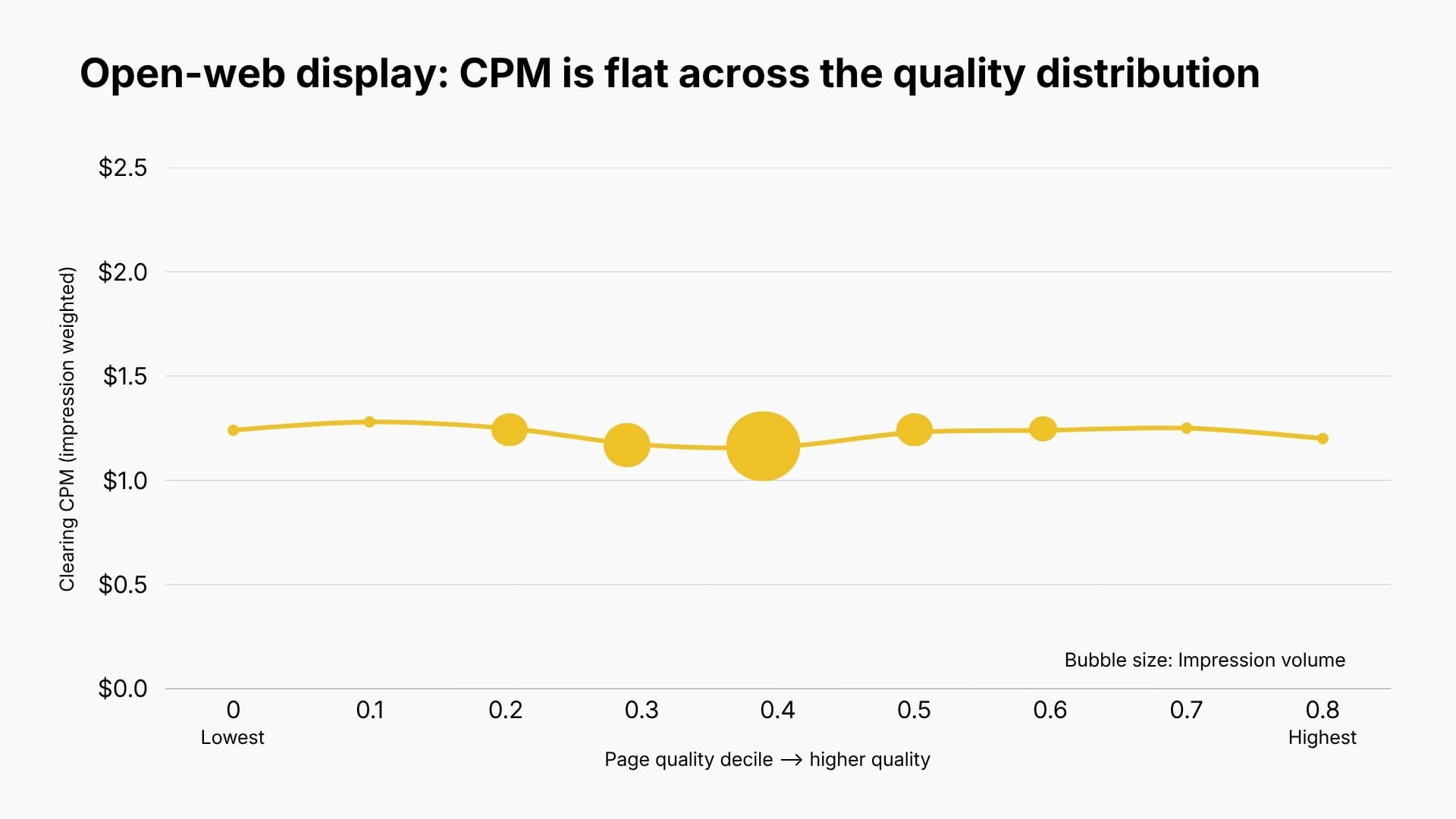
This is a market dysfunction, and it’s worth naming as such. A functioning market for an information good prices observable quality. Buyers willing to pay more for higher-quality assets bid them up, and the relationship between price and quality reflects the information available to participants. Across roughly 1.4 billion impressions of independently scored open-web inventory spanning three enterprise advertisers, that relationship is statistical noise. The information about quality exists. It is being measured. It is predictive, as the Hyundai outcome data later in this piece will show. The market’s clearing prices simply do not reflect it. The natural economist’s question is why a persistent discrepancy of this size hasn’t been arbitraged away by buyers acting on the information. The answer, which we will return to, is structural: until very recently no buyer had the means to act on it inside the auction.
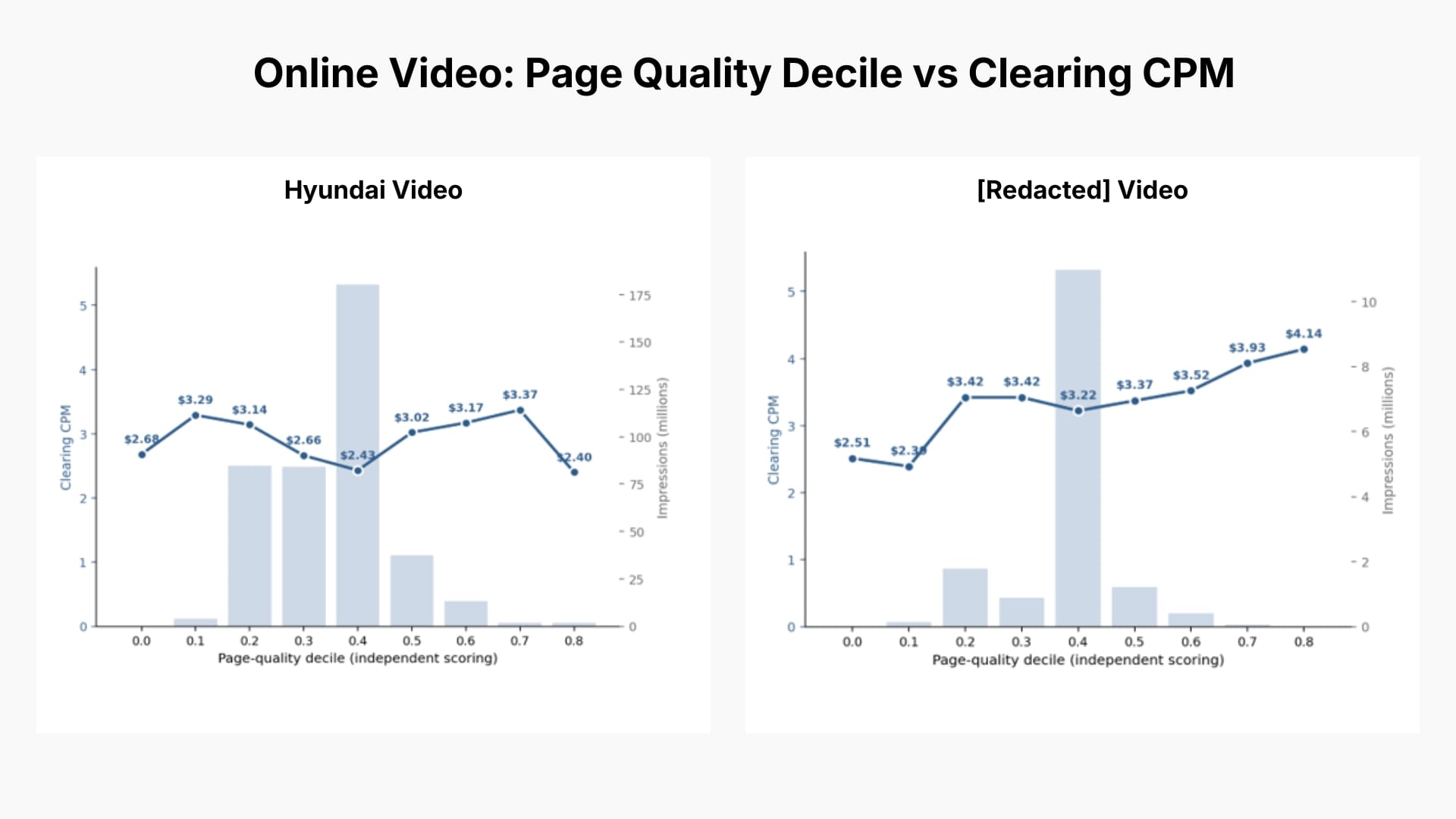
The same dysfunction appears in online video, on a separate supply configuration and at roughly 2.5× the absolute CPMs of display. The chart below shows clearing CPM by page-quality decile for the two video campaigns in this analysis. Neither advertiser’s buying produces a monotone price-quality relationship. Hyundai’s 407 million video impressions cleared within a narrow band that ends below its own middle deciles at the top, with no usable shape between quality and price. Dentsu’s 15.5 million video impressions cleared within a thirty-cent band for 99% of impressions, with the higher-decile tail too thin to move the auction. The shapes differ; the dysfunction is the same. The video market, on the supply paths and at volumes that move money, is not pricing page quality with the fidelity independent scoring shows is available.
Summary of the 6 Cuts
None of this is a critique of SSPs or DSPs. They are running the market mechanism the architecture of pooled, population-scale decisioning permits. The signals that travel in the bidstream are a small subset of what determines outcomes. Page-level quality signals enter the scaled decisioning algorithms, when they enter at all, as universal modifiers calibrated to the pooled customer base. Universal modifiers improve price discovery for the population average. They cannot improve it for an enterprise advertiser with unique, uncommon values, because they are not built to. The dysfunction is the gap between what individual enterprise advertisers know about quality against their own outcomes and what the pooled pricing mechanism can incorporate. The data above quantifies the size of that gap on roughly 1.4 billion impressions of open-web inventory in 2026. It is large.
What an Enterprise Advertiser Did With
That Gap
The data above shows how the open-web market is pricing against independent quality scoring. The natural follow-on question is how an advertiser might wire that scoring into buying decisions trained on their own outcomes, rather than using it after the fact to explain variance.
The Hyundai campaign from which the data above was pulled is also the source of an answer to that question. No conventional pooled DSP algorithm controlled Hyundai’s page decisions in that campaign. Instead, Hyundai’s private model of value was deployed in a shared-compute decisioning environment where the advertiser’s logic executes at the auction. The industry has standardized this type of environment, co-developed by Index Exchange and Chalice AI in 2024, as the Agentic Real-Time Framework, or ARTF. The acronym is worth unpacking:
· “Real-time” refers to Open Real Time Bidding, the auction protocol every open-internet DSP participates in; ARTF doesn’t change the auction.
· “Agentic” refers to the advertiser running its own decisioning logic at the moment of the bid.
· “Framework” is the infrastructure layer: shared compute hosted at or near the supply side that lets multiple parties run per-advertiser logic against the same auction without each having to build their own bidder.
The bidstream is the same. The signals available out-of-band are the same. What is different is decisioning against the individual advertiser’s value function with the individual advertiser’s data, rather than against a pooled value function calibrated on a platform’s buyer population.
In ARTF, Hyundai’s campaign used page-level quality scoring as a feature in a Hyundai-specific value model. The model identified inventory that the Hyundai-specific value function predicted would drive vehicle details page visits, with URL-level signals weighted to Hyundai’s outcomes rather than to pooled conversion data. The price-quality data shown above is what the market priced. The decisioning was what Hyundai’s value function priced.
The results, against the comparable cohort of online video campaigns Hyundai’s agency had visibility into, were a 67% reduction in OLV CPMs and a 20% reduction in cost per vehicle details page visit relative to the next-best performing line. The cost per visit reduction is the more important number. It indicates that the cheaper inventory was not merely cheaper but actually more productive against the campaign’s downstream KPI. Critically, inventory that a pooled, survivor-trained stack would have priced as low-value, and which universal quality modifiers would down-bid for the median advertiser, was, when scored against Hyundai’s specific value function, exactly where the campaign’s economics worked.
This is the answer to the economist’s question from earlier. The arbitrage between market price and per-advertiser value persists at billion-impression scale because, until very recently, no buyer had the means to act on it inside the auction. Hyundai’s campaign is what acting on it looks like once the means exists. The mispricing isn’t a quirk of one campaign. It’s a property of the current market, and Hyundai’s 67% and 20% are what an enterprise advertiser captures when they decision against their own outcomes rather than against the pooled stack’s consensus
Why this opening is appearing now
It’s worth being precise about what changed and what didn’t. The richer page-level signals were measurable five years ago and are measurable now. The auction protocol is the same. What changed is the compute economics of decisioning.
For most of programmatic’s history, the only way to do real-time bidding at scale was to consolidate decisioning into shared pooled software. A small number of large bidders run a single optimization stack across their entire customer base. The economic argument for that architecture was straightforward: standing up a bidder, integrating with the supply side, maintaining QPS at auction speed, and amortizing the engineering cost across enough advertisers to make it work required scale that no individual enterprise advertiser could justify on their own. Pooling decisioning was a compute and integration constraint, not a strategic choice. Universal modifiers, pooled feature spaces, and survivor-aligned optimization followed from that constraint. They were what the architecture made affordable.
Shared-compute decisioning environments at the supply side change the constraint. ARTF and equivalents let advertisers run per-advertiser logic against the same auctions. The integration work is done once, at the framework layer, rather than once per advertiser. The economics that forced pooled decisioning no longer hold. What enterprise advertisers can now do at auction is what the pooled stack was structurally never built to do: apply their own private valuation, their own data, their own quality scoring, weighted to their own outcomes, at the moment of the bid.
The pooled stack is best fit to serve the long tail of advertisers whose private information is product and creative rather than per-customer valuation. Improvements will sharpen the platform’s pricing in directions broadly consistent with what the cross-campaign data suggests the market has been mispricing. We expect the consolidated stack to keep getting better at what it’s built to do.
The architectural complement to that work is what enterprise advertisers can test: per-advertiser decisioning with rich signals applied against the individual advertiser’s unique value function. These are not competing architectures so much as adjacent ones, sized to different populations of advertisers, addressing different ends of the price-quality distribution. We expect, over the next year, considerable cooperation between the pooled-stack platforms and the shared-compute infrastructure providers. The interesting questions are about how the two architectures interoperate, not which one wins.
What this means for enterprise media
decisions in 2026
The data above quantifies how much price-quality decorrelation is sitting in the open-internet auction at any given moment. The Hyundai campaign demonstrates what an enterprise advertiser captures when decisioning runs against their own value function in shared-compute environments rather than against the pooled stack’s consensus. The infrastructure to operate that way exists, is running today on real campaigns, and is becoming progressively easier to access as the framework layer matures. The decision in front of enterprise advertisers in 2026 is whether their own private information is worth more applied through the pooled stack’s definition of quality, or through their own.