
The Two Architectures, Part 5: The Indistinguishable Customer


August 11, 2026
Part one argued that media services is splitting into two businesses with different architectures. One is pooled, platform-driven decisioning for the median advertiser. The other is per-advertiser decisioning for the enterprise, whose competitive position depends on private valuation the pooled stack cannot accommodate. Part two measured the inventory side of that split. Across roughly 1.4 billion open-web impressions, clearing price and independently scored page quality were statistically unrelated, and one enterprise advertiser captured a 67% lower CPM and a 20% lower cost per outcome by scoring against its own value function. Part three argued the split is reaching measurement, where the seller’s attribution lens credits demand the advertiser already had. Part four took the page-quality signal away and scored the bluntest dimension on the board, location. The gap was still there. The pooled stack optimizes a national aggregate, and a national advertiser’s value is local and uneven, so the stack funds the markets already winning and starves the ones that are behind.
Each of those arguments invites the same rejoinder. Perhaps the problem is simply data. The open web is signal-poor. Third-party identity is fragmented. Attribution is noisy. Give a pooled system enough first-party, deterministic, purchase-level data, the reasoning goes, and all blind spots will close. This final part takes up the strongest version of that claim. There is now an entire category of advertising built on having precisely that data. If the limit were ever data, retail is where it would disappear.
The strongest pooled stack
Retail media networks are some of the most data-rich advertising businesses ever built. A retailer sells ad inventory while activating its first-party purchase records, loyalty files, basket histories, and point-of-sale data, to target and to measure. The signature capability is closed-loop attribution. RMNs match ad exposures to actual transactions inside their own ecosystem, online or in store, without a cookie or a probabilistic guess. It does not infer that a sale happened. It rang it up.
US retail media spend reached about $60 billion in 2025 and is on track for roughly $71 billion in 2026, with Amazon holding close to 80% of it, according to eMarketer. Budgets are moving for exactly the reason this series has described. A CMO in a room with a CFO can point to retail media as the one line item that ties spend to a verified purchase. It is the pooled stack with rich conversion data on every customer. If the enterprise’s problem were thin or borrowed data, the retail media network should be immune to it. It owns the transactions.
What “closed loop” doesn’t mean
And yet it inherits the precise limitation parts three and four described.
The network’s native currency is attributed sales, a purchase matched to an exposure within its own walls. Attribution, however clean, answers what happened, not what the advertising caused. The industry now says so in its own research. A 2026 study by Albertsons Media Collective, Ovative, and Northwestern’s Kellogg School, across 42 onsite campaigns, found that incremental return on ad spend could swing 6.5 times and reverse direction in 83% of campaigns, on methodological choices made inside the closed loop alone. Advertisers know it. The ANA reports that 71% now rank incrementality as their single most important retail-media KPI, ahead of ROAS, and roughly three-quarters of marketers say their measurement systems lack the speed, accuracy, or trust they need. Closed-loop attribution verifies the purchase. It does not establish that the purchase would not have happened anyway.
For a household-name brand, that distinction is the whole game. Most of its attributed sales inside a retailer are its existing buyers, the loyal customer reaching for the brand she always buys, now with a sponsored placement served alongside. An optimizer tuned to attributed sales learns, with the best data in the market, to find her again. The network’s data advantage makes it superb at recognizing the customer the brand already has. That is the harvest, executed at the highest resolution available.
The indistinguishable customer
A brand’s growth problem is the household that has not bought yet. Penetration requires reaching the new-to-brand buyer and by ceasing to pay for the loyal one. This fact defeats the data-first claim. On the attributes any pooled system can target, including the retail media network’s, the new-to-brand household and the loyal household are the same household.
We measured it directly. The audiences of a leading household analgesic brand were profiled across hundreds of shared demographic and interest attributes drawn from a standard household-data spine. This is the same vocabulary of age, income, household composition, and interest segments that every data vendor, and every retail media network, ultimately sells. Across 334 shared attributes, the new-to-brand and loyal audiences differ by less than two percent of an attribute’s range on three-quarters of them, and by less than five percent on ninety-nine percent of them. Compared as full distributions rather than summary numbers, the divergence between the two has a median of about six-millionths, on a scale where zero is identical and one is nothing in common. That is the divergence you would get by splitting a single crowd in half at random.*
Picture two towns. You run a 334-question census in each, covering age, income brackets, household sizes, pet ownership, travel habits, interest in politics, and presence of children. The answers come back matching to within about a percentage point on every line. By any measurement a data vendor can sell, they are the same town. One town is full of people about to buy the brand for the first time. The other is full of people who already buy it every month. The similarity is beyond close. It’s at the lowest possible level, where sampling noise alone could explain it.
*Source: De-identified audience profiles for a leading analgesic brand, 2025 to 2026. New-to-brand and loyal audiences compared across 334 shared household attributes. Per-attribute index values differ by less than two percent of range on three-quarters of attributes. Full marginal distributions compared by Jensen-Shannon divergence, median about 0.000006 in bits, where 0 is identical and 1 is maximally different. Figures are illustrative of a typical enterprise brand’s audiences, not a claim about any one campaign.
The shadow and the object
Begin with the type of universal modifier that works. Suppose a brand only needs to discern a vitamin shopper from a beer shopper. Those are two different kinds of people. They differ on the attributes a data vendor sells. A single cut along the threshold that defines a segment sorts them. This is the case shared data handles well. Beer shoppers are younger than vitamin shoppers.
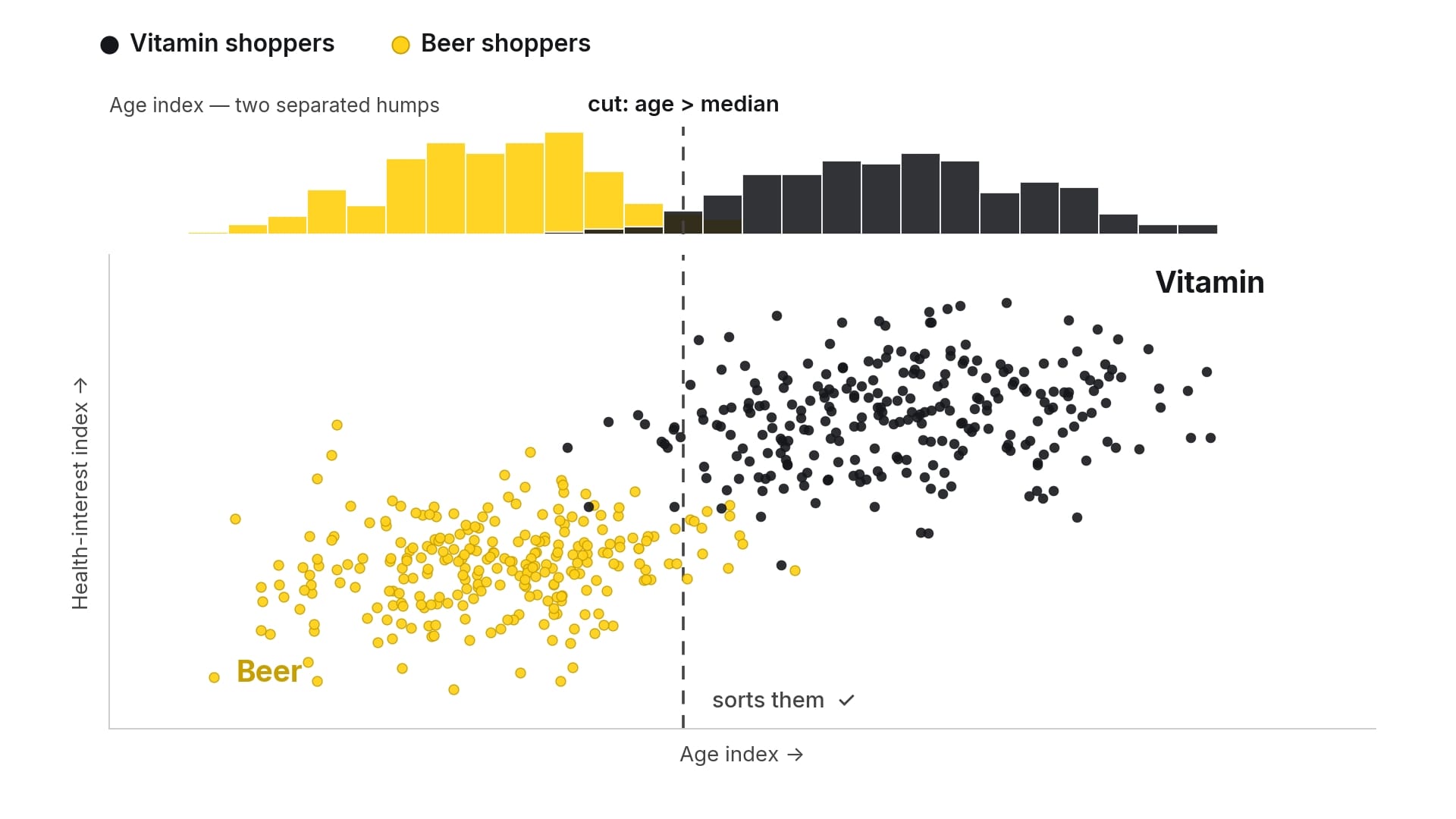
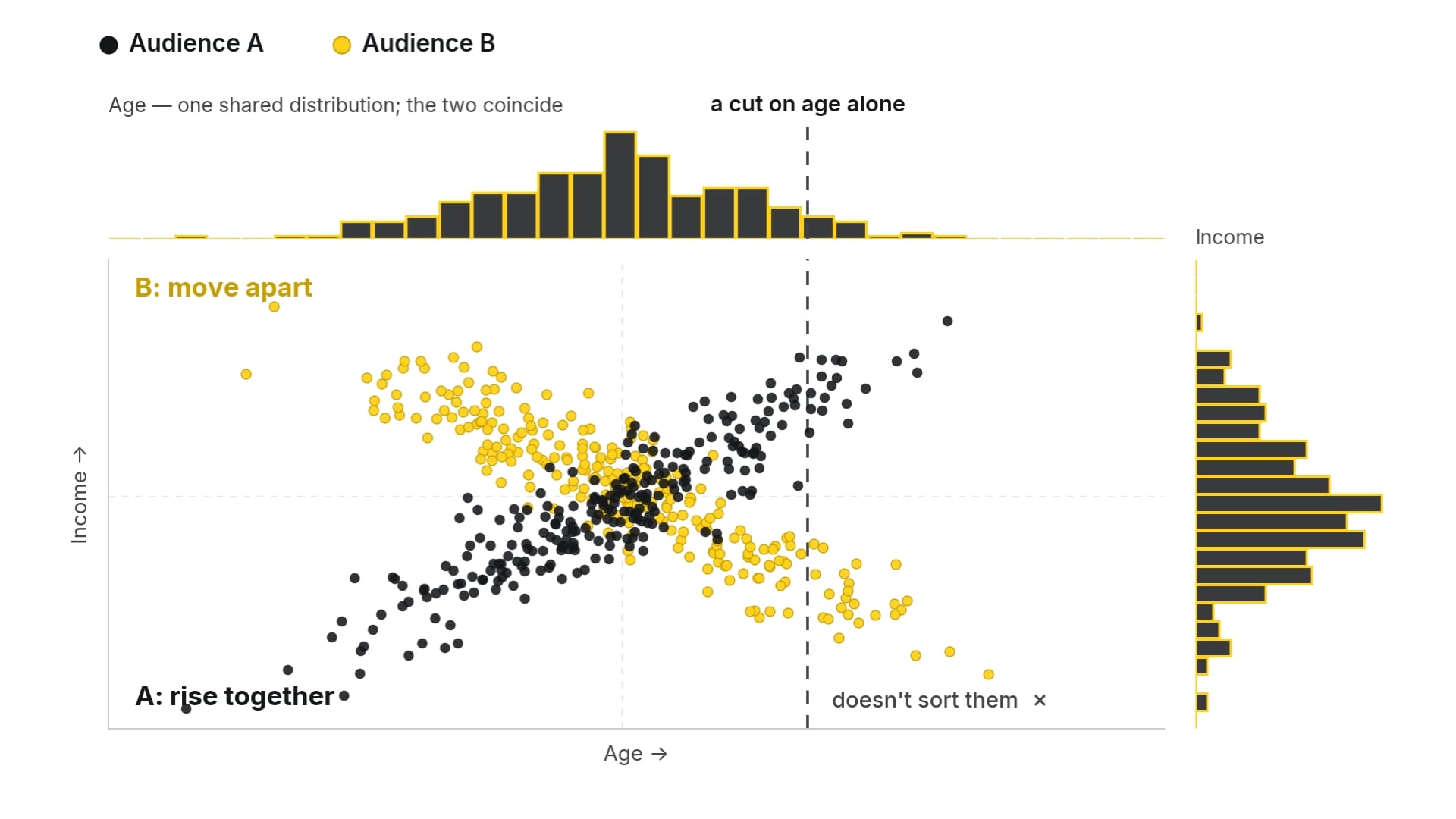
Now the job that matters. Inside one category, separate the household that will become a new customer from the one already loyal. These are not two kinds of people. They are the same kind, with the same profile. On every poolable attribute the two are one distribution, so every single-attribute cut takes the same share of each. No segment moves them apart.
Identical shadows do not mean identical objects. A cloud tilted one way and a cloud tilted the other throw the same shadow on every wall, and differ only seen in the round. The histograms are the shadows. The scatter is the object. The difference between the next customer and the current one is not in how much of any attribute they have. It is in how their attributes co-occur.
This is not a thought experiment. Measured across dozens of household brands, tens of thousands of households each, a brand’s new-to-brand and loyal buyers index identically against the general population in every segment a data vendor sells. A model built on combinations of attributes separates genuinely different populations, new from loyal, at roughly ten times the distance. The object is real, and a model built to quantify it can do so.
This is how Chalice models targets for growth. We fit the joint not to admire the geometry but to measure the difference between two seeds, the brand’s new buyers and its loyal ones, and build from that a custom value function. It bids the would-be-new household up and leaves the loyal one alone, so the brand grows without paying a second time for the customer it already has. We built it this way because we listened to what the best large advertisers actually demand, which is the next customer, not another receipt from the last one.
The retail media network turns its modeling to the opposite purpose. Point a conversion model at attributed sales and more precision does not find growth. It only harvests. The way to be nearly certain of future attributed conversions is to catch decisions already made, as if the model had read the household’s mail, and claim sales that were coming anyway. The standard converter lookalike starts from that edge case and extrapolates. The lowest cost per attributed purchase comes from staying loosely within the existing-customer profile, broad enough to pace and safe enough to convert. The unique signals that mark a real growth target are noise against that objective, and the lookalike throws them out. It is the same modeling craft that turns national brands’ location priorities upside-down. The goal is to harvest, not to grow.
Suppose a network managed to build a custom model of the brand’s growth target despite its pooled stack architecture. It could not run it. That network also serves the brand’s competitors. A shared model cannot take one client’s side against another it works for at the same time. In a category that grows only by taking share (candy, beer, the contracting vitamin aisle the case study below comes from), a real new customer for one brand is one subtracted from a rival, and a model built to win those households is a weapon aimed at whoever is losing them. So the pooled optimizer offers what it can offer to everyone at once, which is reach and resemblance. A model that takes a side has to belong to one advertiser and none of its rivals.
More signal from the same pool would not rescue it. Behavioral data sharpens who is in-market for the category, and the new buyer and the loyal one are both in-market. Intent carries no new-or-loyal tag. If the first brand purchase occurs at a rival store, the transaction that could be used to distinguish new from loyal is one the retail media network never sees. The data-rich stack cannot grade itself on growth, because the label that defines growth is one it cannot apply.
Why the data-rich will not build it
Maybe the solution seems obvious: Stop reading the shadows and read the object. Use client first-party data. Fit a model on the way the attributes combine instead of cutting on them one at a time. Stated that way it sounds like an afternoon’s work for any competent data-science team, and the reasonable next question is why the companies with the most data and the deepest benches have not built it. That question is the heart of the matter. Seeing the problem is free. The insight is public, and this essay is giving it away. Building the thing that solves it requires four things. The pooled incumbents will not do any of them, not for want of talent, but because each one cuts against the architecture and economics that made them successful.
First, the right target. A model is only as good as the label it is fit against, and the label that matters is a genuine new-to-brand buyer, verified against an independent panel outside the seller’s own walls. That is exactly the label the pooled stack cannot use. Its objective is attributed sales, and an honest new-customer target would indict the harvest the stack is built to report. A retail media network cannot optimize against a truth source whose whole job is to say that most of its attributed sales were never incremental. A crude new-customer flag is easy to compute. An honest one is adversarial to its product.
Second, the label has to be built for the brand, and automatic labeling is never good enough. What counts as new is a business question with a different answer for every advertiser. Is a buyer new after ninety days without a purchase, or after a year? New to a single SKU, or new to the whole family of products the brand sells under one name? When a household moves from the brand’s gummies to its tablets, is that a new customer? Or is it is an existing one the model should learn to bid down rather than chase? Get any of these wrong and the model optimizes toward the wrong household with great precision. None of it can be read off a dashboard. It comes from a real working relationship with the brand, from knowing its portfolio, its purchase cycle, and what it means by growth, and from encoding that judgment into the labeling before a single model is fit. A self-serve platform is built to avoid exactly this. Its economics require one automated definition applied across the entire base, because a hand-built target for each advertiser is the opposite of scaled SaaS. The label that would actually work is one a self-serve stack can never afford to make.
Third, the real problem is not the tidy two-dimensional picture. It is hundreds of attributes, most of them thinly populated, a positive class of a few tens of thousands of known converters, and a universe of more than a hundred million households to be scored. Recovering a faint relationship spread across many of those attributes, from a small labeled sample, without overfitting, is genuine work. It pays off only for a model built to one advertiser’s outcome. A model required to generalize across the entire base cannot afford to chase a structure that is real for one brand and absent for the next. The difficulty is not that interactions are exotic. It is that the valuable ones are advertiser-specific, and a pooled objective is the wrong instrument for finding them.
Fourth, the model has to run where the bid happens. A value function in a slide deck changes nothing. It has to execute at auction speed, on live inventory. It can’t require the advertiser standing up and maintaining its own bidder. That infrastructure, per-advertiser logic running in shared compute at the supply side, did not exist until recently, and building it took years and real capital, as part two described. The pooled incumbent can not stand it up within its legacy architecture.
The reason the richest-data companies in advertising have not solved this problem is not that it is too clever for them. It is that solving it themselves means fitting an independent, per-advertiser, incrementality-validated model and running it as their own product, and every one of those choices cuts against the architecture and the economics that made them rich. The moat for the enterprise offering is not the insight. It is everything the insight requires.
The inversion, completed
This is where the thesis of the series resolves. Chalice holds none of the retail media network’s data. No loyalty file, no transaction log, no closed loop of its own. By the data-first logic it should lose every contest. It does the opposite, because it is built to satisfy exactly the requirements the pooled stack cannot. A target defined by the advertiser and validated outside any seller’s walls. A label hand-built for the brand rather than read off a default. The high-dimensional estimation only a single-advertiser model can afford to attempt. And execution at the auction itself. It reads the object, the joint, not the shadow. It optimizes the creation of demand, not the recording of it. The same shared attributes everyone has, a different target, and a representation that preserves the structure the pooled objective throws away. Data-poor, and architecturally exact.
Case study: One A Day and Chalice
In a contracting vitamin category, One A Day’s goal was growth, genuinely new customers rather than re-reach, and most vitamin purchases happen offline, where platform optimization cannot see who already buys in store. Chalice’s growth-scored audiences were measured head-to-head against Amazon DSP, the retail-media leader’s own AI, on the platform that holds close to 80% of US retail media. Chalice acquired new customers 4X more effectively, and the edge held quarter over quarter.
The measurement is the kind this series has argued for. Effectiveness is media-driven sales per thousand impressions, resolved to the Circana new-customer cohort through TransUnion multi-touch attribution, where a new customer is a household that did not buy the brand in the prior 12 months, on or offline. Because credit is assigned only inside that cohort, re-reaching an existing buyer earns nothing. The harvest is excluded by construction.
The offline panel defines the target the platform cannot see: who was actually new, in-store purchases included. A model fit to this one advertiser then learns, from the way attributes co-occur, what a soon-to-be-new buyer looks like, and scores every biddable household, bidding the true prospect up and the existing buyer down, where the platform, reading shared segments, bids them the same.
The comparison was not against baseline, and it was not close. Amazon’s is the most data-rich AI in retail advertising, and a model holding far less data beat it by 4x on the one outcome a growing brand cares about. It was done by reading the object where the pooled architecture reads only the shadow. What is indistinguishable to pooled, shared-segment decisioning is distinguishable to a per-advertiser model using calculations on the joint.
Source: One A Day (Bayer) and Chalice. New-customer effectiveness measured against Amazon through the Circana new-customer (growth) cohort and TransUnion multi-touch attribution. New customer defined as a non-purchaser in the prior 12 months, on or offline.
The store, not the gatekeeper
There is a reading of all this in which the retail media network is the loser. That’s incorrect. The network will not build enterprise models, for every reason above. It does not follow that enterprise models can’t run on the network. Building optimizers and hosting them are different. Hosting a client’s model asks nothing of the network’s own objective, points its optimizer at nothing new, and arms no rival through a product the network made. The network runs the auction. The client’s isolated value function bids into it. One auction host can carry a pooled optimizer for the median advertiser and, beside it, isolated per-advertiser models for the enterprise, under ARTF or its equivalents. The two architectures are separate. They are not incompatible. One company can host both venues.
This turns the real strategic question for retail media networks into one that is not technical at all. A retail media network that stays purely on the pooled stack is trying to be Google. It is using a privileged view of the shopper to make itself a channel no serious advertiser can skip, a must-buy. The trouble is arithmetic. When every retailer runs the same play, none of them is a must-buy, because the same budget can route to whichever treats it best. And the retailer has only one set of customers that finally matters, the brands whose goods it sells. Those brands are its suppliers and its advertisers at once. A stack that taxes them, dictates to them, and grades its own homework against them breeds resentment in the one constituency a retailer cannot afford to lose. Amazon and Walmart have scaled the pooled play furthest, and they will be first to feel where it runs out.
The alternative is the thing a store has always been. A store does not forbid one brand from competing with another on its shelves. It stocks them both and lets the shopper choose. Its power is the floor it owns and the traffic that floor draws, not a thumb on the scale. The hosting model carries that nature into the auction. The retailer provides the arena and the shopper relationship, which are real and valuable, and lets each brand bring its own decisioning and win on its merits. The store that hosts the contest keeps the brands and their budgets. The gatekeeper that tilts a pooled optimizer toward its own yield loses them to whatever venue will not. Being the arena is worth more than being Google, and it is the role the retailer is actually built for.
The One A Day deployment is the early shape of this. A client’s model ran inside the largest retailer’s auction, and the retailer’s own cloud division helped it get there. The networks that lean into that role will host the enterprise tier’s growth budgets. The ones that hold the pooled line will keep the median advertiser and lose the brands that can build an edge of their own.
Conclusion
The demand-side is splitting because the underlying statistics will not let one architecture serve the long tail and the enterprise. The open-web auction leaves page-level value, location value, and even user value mispriced. Per-advertiser models capture what the consensus cannot. Measurement is splitting along the same line. The constraint was never the quantity of data. The distinction is structural, not informational.
An inefficiency that appears once is a quirk a market competes away. One that appears on every axis a pooled architecture touches is a different matter. A shared model is not built to accommodate the unique, private valuations that would price it. This is the arbitrage Meta runs inside its own walls: private per-advertiser valuation set against a market that averages toward consensus. The same opportunity sits unclaimed across the open web, CTV, and retail media networks. Structural mispricing does not close on its own. It is captured by whoever builds the instrument to act on it.
The decision in front of the enterprise in 2026 is therefore not which stack holds the most or the best data. It is whose objective the enterprise’s money optimizes, and whether the model spending it was built for the median advertiser or for this one alone. The customer worth winning is the one no shared segment sees and no closed loop network recognizes, because on every attribute that can be pooled she is indistinguishable from the customer the brand already owns. Reaching her was never a data problem. It was an architecture problem, and enterprise architecture is finally live.