The Two Architectures
While the network side consolidates into infrastructure to serve small advertisers, the whales are leaving for an architecture of their own.


July 17th, 2026
In Q2 2026, two acquisitions told you where advertising is heading. Publicis, the world’s largest media buyer, announced its purchase of LiveRamp, the neutral identity layer that connects advertiser data to the media ecosystem. And Walmart agreed to pay up to $1.4 billion for Vibe.co, a self-serve CTV platform built to put television within reach of small and mid-sized businesses.
These are opposite bets. The network side of advertising is consolidating into pooled, standardized infrastructure for the median advertiser. The largest and most sophisticated advertisers are building decisioning they own and control, going around the pooled stacks. The demand side was one thing and now it’s two. Knowing which one you belong in is the most consequential media decision a brand will make this decade.
The Stack Graveyard
We arrived here after the industry spent a decade and tens of billions proving what does not work.
The 2010s produced a graveyard of attempted “stack” plays. Acquirers bought ad servers, exchanges, and data platforms on the theory that owning the components would manufacture a durable advantage like Google’s or Meta’s. Microsoft bought aQuantive for $6.3 billion and wrote off essentially all of it. AT&T assembled AppNexus into a coherent thesis on paper that carrier culture smothered and sold to Microsoft for parts. Verizon combined AOL and Yahoo into “Oath,” took a $4.6 billion write-down, and sold the wreckage to Apollo.
Assembling Google’s components does not create Google’s advantage. Each acquirer believed control of the plumbing would create leverage and defensible margins. What none of them bought were pipelines to create and deploy billions of predictions in real time. Google and Meta spent years and billions building these around their own media properties. The carriers had data on downloads, purchases, location, and traffic. They lacked the capability to refine data into accurate bid-time valuations at auction scale, in a loop where the same system serves the ad, observes the result, and feeds the next prediction. Even Microsoft, with real engineering behind it, found that buying an ad-serving stack did not deliver a prediction engine. Owning the boxes is not the same as owning the ability to price what flows through them.
The new split is precisely about who owns the decision.
The Network Side Consolidates
Walmart buying Vibe is a smart platform play. Vibe serves mid-sized advertisers who have never bought a TV spot and want to launch from a laptop. Bolt that onto Vizio’s hardware footprint and Walmart’s purchase data, and you get standardized, self-serve, closed-loop advertising at enormous scale. For the median advertiser, pooled is the right answer. They lack the volume, the data, and the in-house capability to justify anything bespoke. A well-run pooled system will serve them better and cheaper than they could ever serve themselves.
Publicis buying LiveRamp, on the other hand, is a hedge. Publicis did not need LiveRamp’s technology for a network play because it already owns Epsilon, a complete pooled stack serving its agencies at scale. What it wanted was LiveRamp’s position: the neutral layer through which advertiser data flows to everyone else. Sophisticated advertisers have begun to pursue custom models, per-advertiser decisioning, and optimization logic no agency or platform can read. By acquiring the neutral translation layer, Publicis is attempting to stay relevant to both sides of the split: the legacy agency business below the sophistication line, and the independent-optimization market above.
The largest incumbent in the business is paying a premium because it sees the split. While the network side consolidates into infrastructure to serve small advertisers, the whales are leaving for an architecture of their own.
A Lesson From Finance
Brands with 9-figure advertising budgets used to assume the platforms hold all the leverage. The history of financial markets says otherwise.
Aggregator power rests on the condition that no individual buyer matters too much. When a small number of sophisticated buyers represent a disproportionate share of volume, that condition fails. At sufficient scale, a large buyer can credibly threaten to route around the aggregator, and the aggregator has to accommodate it.
This is precisely what happened in institutional trading. For decades, large buy-side institutions routed their execution through prime brokers. The brokers held the information advantage, extracted spread on every transaction, and owned the relationship with supply. The biggest clients had no independent way to reach the market, so they paid the tolls. Then hedge funds and quant trading firms used new technology to build direct access, co-location, and proprietary execution logic. The new paths went around the brokers entirely.
This bypass strategy did not eliminate prime brokerage. It stratified the market. Below a certain threshold of sophistication and scale, firms still use brokers. Above it, the relationship irreversibly rebalanced toward the buyer. Once a firm had built the capability to route independently, the cost of going back to broker dependence was higher than the cost of staying independent. The path around the broker, once established, becomes permanent.
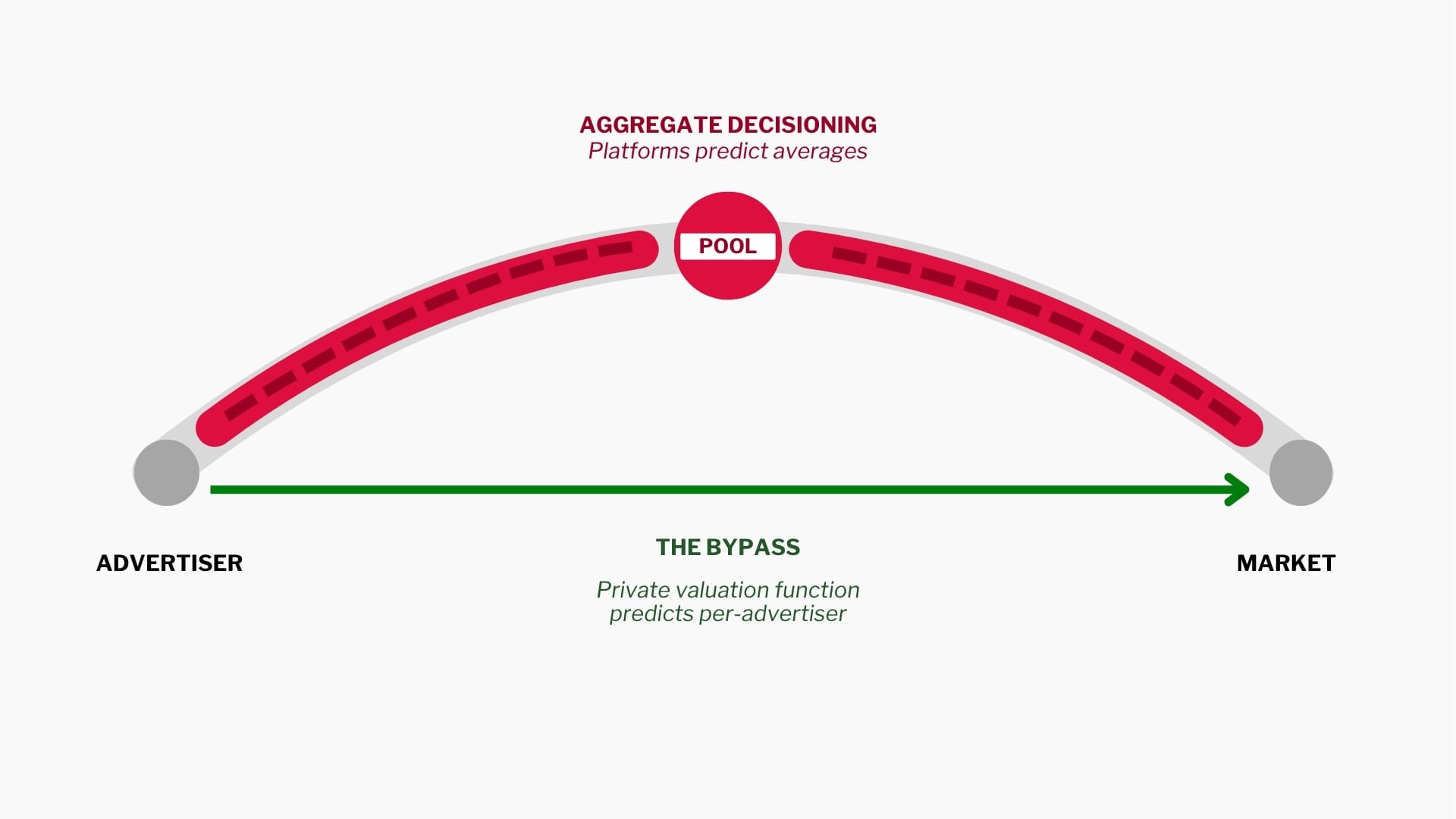
Advertising is now at the equivalent inflection. The pooled stack is the prime broker. It holds the model advantage, extracts margin, and owns the supply relationship. The largest advertisers have the volume to bypass it. What they lacked, until recently, was the capability.
The Bypass Goes Public
For most of the last decade, “build your own bidder” was a slogan more than a practice. It now has working, public proof points.
Hyundai tested running its CTV bidding through a containerized model built by Chalice AI and deployed inside the SSP OpenX. Hyundai's model bid via a direct, low-latency connection to the source, instead of waiting for a platform to act on its behalf. The pilot covered three vehicle models. Hyundai is now extending it across the entire fleet.
Hyundai's CMO, Sean Gilpin, is explicit that the goal is not the usual chase for a cheaper CPM. The point is reaching the right potential car buyers and owning the apparatus that identifies them. He doubts a brand "gets a unique competitive advantage with off-the-rack platform elements" like Google's Performance Max. When it comes to the decision-making knowledge about which impressions and audiences turn into car buyers, at what cost, Gilpin's framing is blunt: "we want to own that."
That sentence encompasses the entire business case for the enterprise architecture. Both architectures do the same work. They center decisioning on value-to-cost ratio, using predictive power to surface value in the long tail of impressions, where no obvious signal exists. The pooled stack is good at this. It sees more advertisers, more categories, and more supply than any single buyer. The industry has learned to mistake that breadth for predictive power. But breadth is not what the enterprise customer demands. Platforms optimize toward generic outcomes on signals shared across all the advertisers they serve. They can’t optimize on Hyundai's private definition of an auction worth winning. If Hyundai is trying to steal share from Toyota, a value prediction shared by Hyundai and Toyota is never going to work. More data about everyone can mean less data about the one thing a single advertiser is trying to predict.
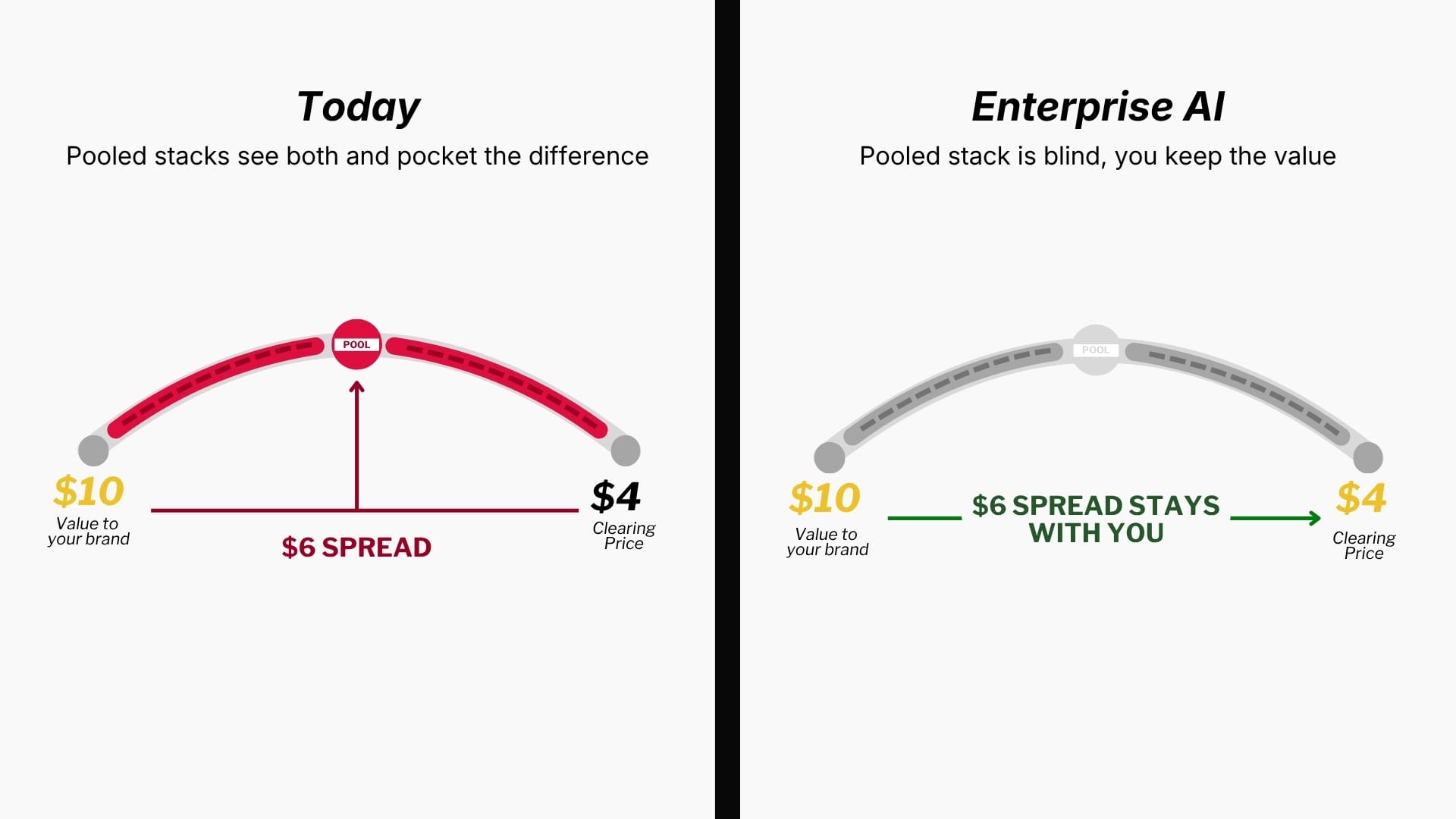
Custom valuation finds better value, but the larger prize is the spread. When a model values an impression at $10 that clears at $4, someone keeps the $6. In open RTB, the incentive has always been to take it clandestinely. Every programmatic controversy from US v. Google to the fights over supply-path optimization is rooted in intermediaries positioned to capture spread without the buyer noticing. Per-advertiser modeling drags that contest into the open. The brand runs its own value function, bids into supply it reaches directly, and keeps the spread its own model finds. Surplus accrues to the buyer whose model found it. A market where advertisers compete for spread on the merits of their own predictions is cleaner and more efficient than one where intermediaries skim it in the dark.
That said, platforms will try to price spreads away. Two things stop them. When Hyundai builds and runs its own model, it knows things about that model the platform does not. It can withhold data that would let a platform reconstruct its logic. A sell-side system cannot accurately price against a valuation computed from data it does not hold. The pooled stack extracts spread precisely because it sees both the prediction and the clearing. Split the two and the informational advantage runs the other way.
Hyundai is also benefiting from competition among venues. Per-advertiser modeling is standardized by the IAB Tech Lab as ARTF, the Agentic Real-Time Bidding Framework. Index Exchange and Chalice co-developed the standard, OpenX adopted second, and others are moving the same direction. An advertiser can deploy the identical model across every ARTF environment and compare what each impression actually costs. A host that prices the spread away will lose that bid to one that does not. Portability turns the buyer's model into a check on every venue at once.
Choosing Your Architecture
The enterprise alternative to pooled-stack architecture is a disaggregation play. It is not theoretical. It has a customer base in the top 2,000 advertisers, who control the majority of open-internet spend. They are increasingly aware that their private data and valuations are competitive assets no counterparty should be allowed to claim and use to train its own AI. It has working infrastructure, now that buy-side decisioning can be hosted under a standardized, per-advertiser framework. It has proof points. And it has M&A catalysts. The largest media buyer in the world paid a premium to hedge against the split, and the largest retailer in America acquired an SMB platform for $1.4B to consolidate the network side.
In the institutional-trading migration, each firm had to build its bypass internally at great cost. Advertising’s version can be external and shared at the infrastructure layer without pooling any single advertiser’s private logic. Each model remains specific to one buyer’s objectives, one buyer’s data, one buyer’s competitive context. It cannot be commoditized or pooled without destroying what makes it valuable. Per-advertiser decisioning is per-advertiser by definition.
The two architectures are both now funded, public, and accelerating. The only decision left to a brand is which one it belongs in. For the advertisers with the most at stake, the finance precedent is not a forecast. It is a description of what is happening.